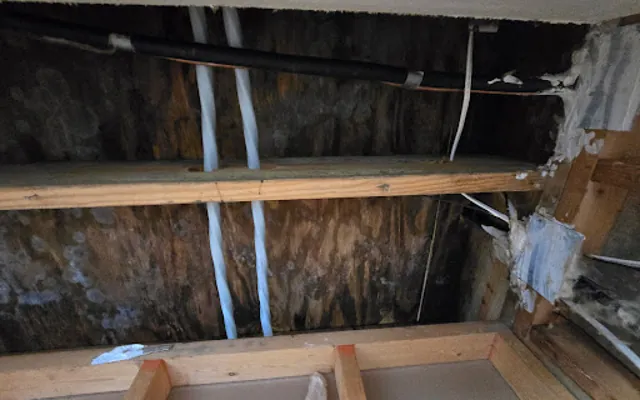
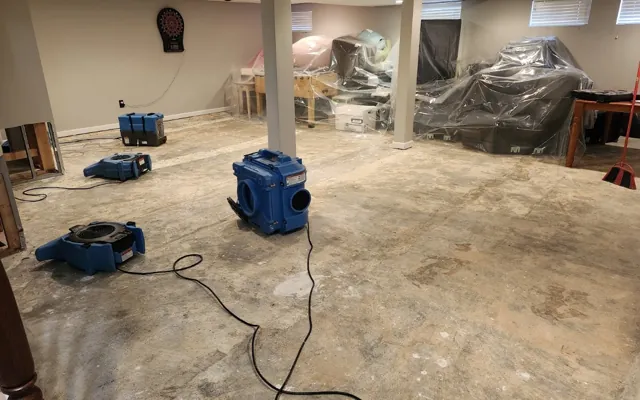
Attic water damage in Northwest Chula Vista's original 1950s bungalows often starts as slab leaks or failed water heaters. The IICRC-standard crews respond fast to trace the leak and extract water before structural damage spreads.

Crews inspect roofing, flashing, HVAC drain lines, and vent boots to pinpoint whether the water is coming from the roof, a failed water heater, or a burst supply line under the slab before opening walls.
Saturated insulation is removed and truck-mounted equipment pulls standing water from the attic floor or ceiling cavity while crews take moisture readings on framing and decking to establish a baseline.
Air movers and dehumidifiers run continuously, drying rafters, decking, and the ceiling drywall below while crews track moisture daily with meters until the structure reaches safe levels throughout Northwest Chula Vista.

Attic water damage cleanup in Northwest Chula Vista usually runs $600 to $4,500, depending on how much insulation needs replacing, whether ceiling drywall below has to come down, and if the roof or an HVAC drain line needs repair. Homeowner's insurance typically covers sudden leaks such as a failed drain line or storm-driven roof damage, though gradual neglect is usually excluded. Crews document everything for your adjuster.
Pre-1960 homes in Third Ave Village and surrounding blocks run aging copper and galvanized supply lines under concrete slabs where a pinhole leak travels silently until it surfaces as a warped floor or damp baseboard. When coastal humidity accelerates mold growth in Northwest Chula Vista's oldest neighborhoods, speed matters to prevent that hidden leak from becoming a long-term problem. Northwest Chula Vista's slab-on-grade construction combined with decades-old water heaters, corroded copper supply lines, and cast iron drain lines creates a steady stream of slab leaks and sewer backups. The first hint a homeowner gets is often a warm spot on tile or a suddenly high water bill. From Northwest Chula Vista, crews also cover nearby Terra Nova, Castle Park, Harborside, Rancho del Rey, Bonita, National City. See every neighborhood and town on the full service area page.
See all areas servedEvery loss is photographed, measured, and logged from the first visit, so the paperwork holds up with your insurance carrier.
Technicians follow recognized IICRC drying standards and prove the work with daily moisture readings, not guesswork.
Emergency dispatch any hour of the day or night, with a real crew on the way, not a callback in the morning.
A real crew dispatched any hour, not a callback in the morning.
Trained technicians following recognized IICRC drying standards.
Truck-mounted, portable, and submersible for any size loss.
The loss is documented and billed to the carrier directly.
Pre-1960 and 1960s-era homes in the northwest core used copper and galvanized steel supply lines run under concrete slabs. After 40 to 70 years, pinhole corrosion or joint failures are common, and the slab hides the leak until water shows up in walls or floors above. Coastal humidity and salt air accelerate that corrosion in older neighborhoods.
Insurance typically covers sudden water events such as a burst supply line or failed water heater connection, but gradual leaks from pipe corrosion are often denied. Crews photograph and document exactly what crews find so your adjuster can make that determination based on evidence, not assumptions.
Crews are on call 24 hours a day and can be on the way to Northwest Chula Vista within the hour.
Call (619) 651-9086