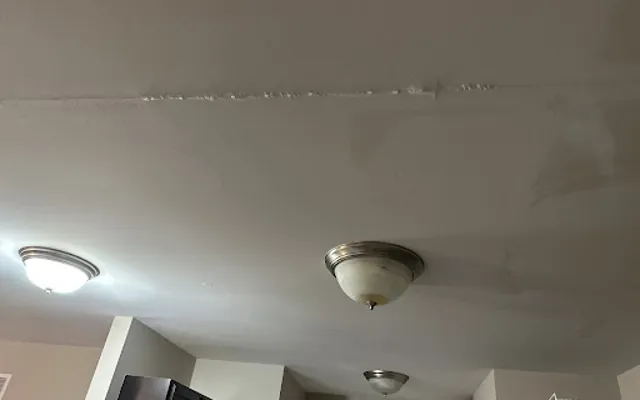
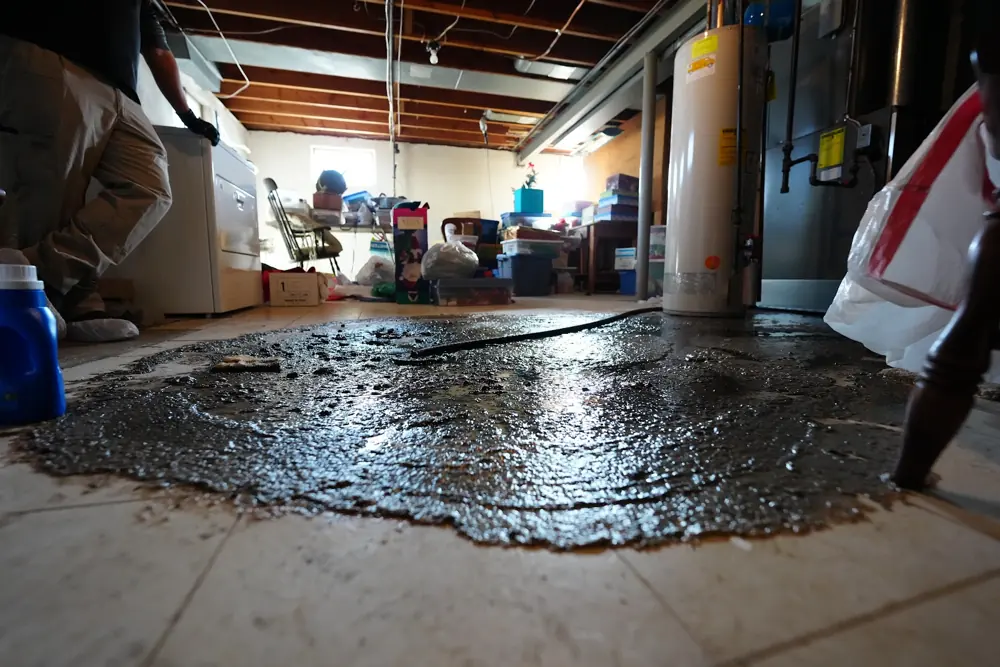
A brown stain overhead almost always means active water above it. Crews reach most Chula Vista homes in about an hour to stop the source and dry the ceiling cavity properly.

Crews trace whether the leak is from the roof, an upstairs fixture, or HVAC condensation before opening or drying anything.
Trapped water above the drywall is released in a controlled way and extracted along with any pooling on the floor below.
Air movers and dehumidifiers dry the ceiling cavity, joists, and insulation while moisture is checked daily until safe.
Sagging or stained drywall sections are cut back, replaced, textured, and repainted to match the surrounding ceiling.

While help is on the way, these first steps, done only where it is safe, limit the damage and protect the insurance claim.
Shut the supply off at the source, or close the home's main valve if the source is not obvious. Stopping the flow limits the damage more than anything else.
Switch off electricity to the affected area, but only if the breaker can be reached without standing in or touching the water.
Get a crew dispatched right away. The sooner extraction and drying begin, the more flooring, drywall, and belongings can be saved.
Take photos and a short video of the water and the affected rooms before anything is moved, so the insurance claim starts strong.
Ceiling water damage repair in Chula Vista typically runs $450 to $3,500, depending on the size of the stained or sagging area and whether the source is a simple fixture leak or a roof repair. Insurance usually covers sudden leaks such as a burst supply line or storm damage, while a long-ignored slow leak is more often treated as a maintenance issue.
Crews reach Chula Vista and the South Bay fast, from Eastlake and Otay Ranch to Rancho del Rey, Terra Nova, and Third Ave Village, and nearby Bonita and National City. See the full list on the areas served across Chula Vista page.
See all areas servedEvery loss is photographed, measured, and logged from the first visit, so the paperwork holds up with your insurance carrier.
Technicians follow recognized IICRC drying standards and prove the work with daily moisture readings, not guesswork.
Emergency dispatch any hour of the day or night, with a real crew on the way, not a callback in the morning.
A real crew dispatched any hour, not a callback in the morning.
Trained technicians following recognized IICRC drying standards.
Truck-mounted, portable, and submersible for any size loss.
The loss is documented and billed to the carrier directly.
Not always, but you should treat it as one until proven otherwise. Some stains are old and dry, but the only way to know is to check moisture levels with a meter, which is the first thing crews do on any ceiling call.
Yes, if enough water accumulates above the drywall, the weight can cause it to fail suddenly. If you see active sagging or dripping, keep people out of the room and call immediately rather than waiting to see if it drains on its own.
Crews handle the water damage restoration, structural drying, and drywall repair, and crews coordinate directly with a roofer or plumber for the actual source repair so everything is fixed together instead of leaking again.
Sudden leaks from a burst pipe, storm damage, or an accidental fixture failure are typically covered. A ceiling stain from a leak that has clearly been dripping for months without repair is more often viewed as deferred maintenance.
Once moisture readings in the drywall and framing are back to normal, usually 3 to 5 days after extraction, crews can proceed with drywall repair, texture, and paint, typically within a day or two after that.
Chula Vista crews are on call 24 hours a day, local and fast, and can be on the way within the hour.
Call (619) 651-9086