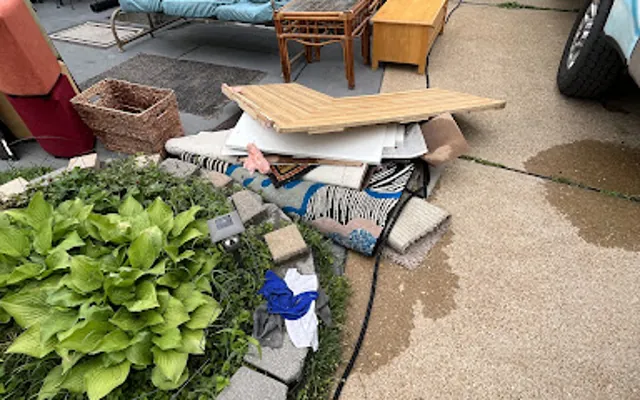
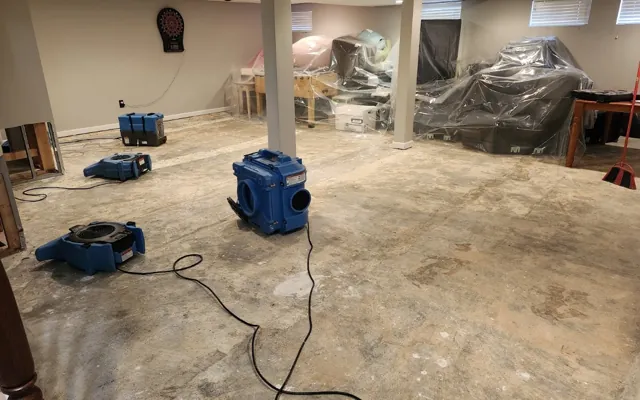
Rolling Hills Ranch's 2000s hillside homes face slab leaks that travel further on terrain. Crews use specialized drying strategies for sloped construction.

Crews account for the sloped terrain when determining where water will pool and flow. Pumping and positioning are adjusted for hillside drainage patterns.
Materials are tested throughout the affected zone, accounting for how water travels on sloped lots. Deeper excavation or drying may be needed downslope from the break.
Equipment is positioned to work with the natural drainage of the hillside rather than against it. Daily testing ensures water is pulled from the slab and framing despite terrain challenges.

Water main break cleanup in Rolling Hills Ranch typically runs $1,000 to $9,000, depending on how much water reached the home and whether it affected a garage, crawlspace, or interior flooring. The pipe repair itself is billed separately, either by the city for a public main or a plumber for a private service line. Coverage depends on which line failed, and crews document the source and spread carefully to support the right claim.
Rolling Hills Ranch is a 2000s-built neighborhood in northeast Chula Vista where the original owners still make up much of the community. These homes are newer than the west side's stock, but two decades in, water heaters and slab supply lines are reaching the point where failures become common, and a leak on one of these hillside lots can travel further before it is noticed. Rolling Hills Ranch's hillside terrain means water from a slab leak or main break can travel further downslope than on flat ground. Original water heaters and supply lines from 2004-2006 are now nearing failure age. The terrain also affects how groundwater pressure acts on foundations. From Rolling Hills Ranch, crews also cover nearby Eastlake Trails, San Miguel Ranch, Eastlake Vistas, Coronado, San Ysidro, Bella Lago. See every neighborhood and town on the full service area page.
See all areas servedEvery loss is photographed, measured, and logged from the first visit, so the paperwork holds up with your insurance carrier.
Technicians follow recognized IICRC drying standards and prove the work with daily moisture readings, not guesswork.
Emergency dispatch any hour of the day or night, with a real crew on the way, not a callback in the morning.
A real crew dispatched any hour, not a callback in the morning.
Trained technicians following recognized IICRC drying standards.
Truck-mounted, portable, and submersible for any size loss.
The loss is documented and billed to the carrier directly.
Water travels downslope, so standing water may pool far from the actual break. Crews map the terrain and position equipment to pull moisture from the full affected zone, not just the immediate break area.
Drying can be slightly longer because water distribution is more complex. Crews adjust equipment positioning daily based on how moisture is traveling. Terrain does not excuse incomplete drying.
Crews are on call 24 hours a day and can be on the way to Rolling Hills Ranch within the hour.
Call (619) 651-9086